What Is Web3? Meaning, Examples, and Honest Criticism
Web3 is the idea of a new stage of the internet in which users own their accounts, data, and digital assets directly, using blockchains, in place of large companies owning them. In Web3 you log in with a crypto wallet, not a username and password, and apps run on public smart contracts that no single company controls. The term was coined in 2014 by Gavin Wood, a co-founder of Ethereum.
Web1, Web2, and Web3
| Web1 (about 1990 to 2004) | Web2 (about 2004 to today) | Web3 (emerging) | |
|---|---|---|---|
| Short description | Read | Read and write | Read, write, and own |
| Content | Static pages | Created by users | Created and owned by users |
| Who controls | Website owners | Large platforms | Users and communities |
| Login | None or simple | Email, or "Sign in with Google" | Crypto wallet |
| Money | Rare online | Cards, banks, payment apps | Built in: crypto and tokens |
| Data stored | Web servers | Company databases | Blockchains and decentralized storage |
| Examples | Personal home pages, early portals | YouTube, Instagram, Uber | Uniswap, ENS, Farcaster |
- Short description — Web1 (about 1990 to 2004): Read; Web2 (about 2004 to today): Read and write; Web3 (emerging): Read, write, and own
- Content — Web1 (about 1990 to 2004): Static pages; Web2 (about 2004 to today): Created by users; Web3 (emerging): Created and owned by users
- Who controls — Web1 (about 1990 to 2004): Website owners; Web2 (about 2004 to today): Large platforms; Web3 (emerging): Users and communities
- Login — Web1 (about 1990 to 2004): None or simple; Web2 (about 2004 to today): Email, or "Sign in with Google"; Web3 (emerging): Crypto wallet
- Money — Web1 (about 1990 to 2004): Rare online; Web2 (about 2004 to today): Cards, banks, payment apps; Web3 (emerging): Built in: crypto and tokens
- Data stored — Web1 (about 1990 to 2004): Web servers; Web2 (about 2004 to today): Company databases; Web3 (emerging): Blockchains and decentralized storage
- Examples — Web1 (about 1990 to 2004): Personal home pages, early portals; Web2 (about 2004 to today): YouTube, Instagram, Uber; Web3 (emerging): Uniswap, ENS, Farcaster
Web1 let you read. Web2 let you post, comment, and share, and in exchange a few platforms came to own the data and set the rules. Web3 aims to let you own what you create and hold.
The problem Web3 wants to solve
In Web2:
- A platform can close your account, and your followers and content are gone.
- Your data is the product. It is collected and sold to advertisers.
- Platforms take a large share of creators' income and can change the terms at any time.
- You cannot move your profile or your purchases from one platform to another.
Web3 proposes that accounts and assets live on a public blockchain that you control with your own keys, so no company can take them away.
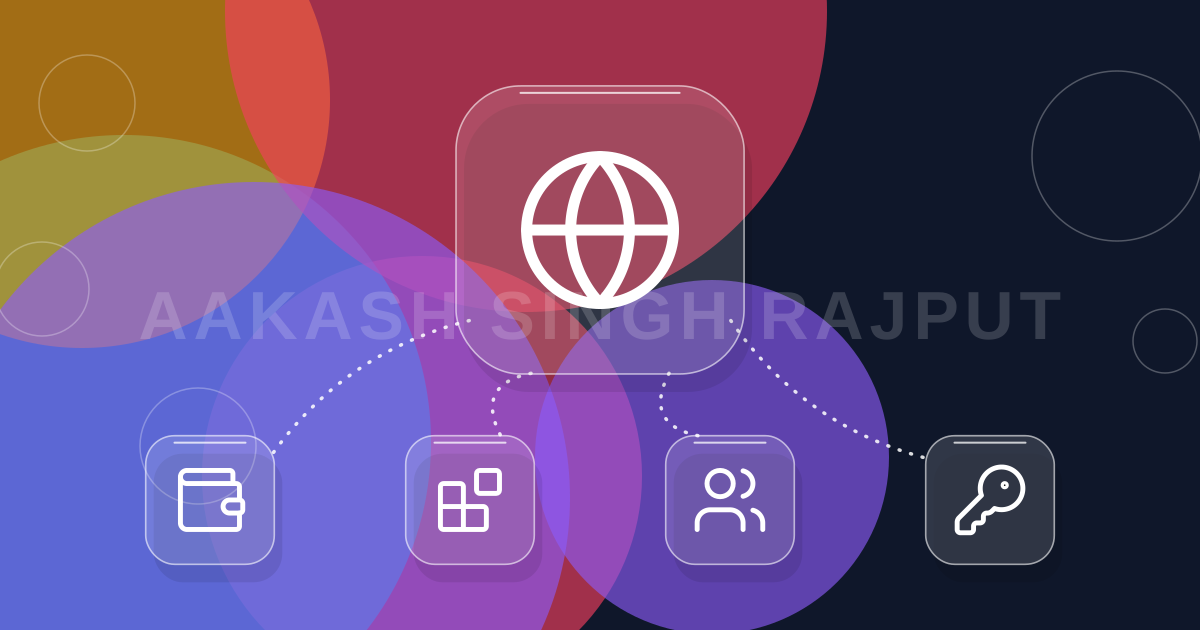
The building blocks of Web3
Blockchains
A shared record that no single party controls. It replaces the company database. See what blockchain is.
Smart contracts
Programs on the blockchain that run by fixed, public rules. They replace the company's back-end server. See what a smart contract is.
Wallets
A wallet holds your private keys. It is your login, your identity, and your bank account in one. See how crypto wallets work.
Tokens
- Fungible tokens work as money, shares, or voting power.
- NFTs record ownership of unique items. See what an NFT is.
Decentralized storage
Blockchains are too expensive for large files, so systems such as IPFS and Arweave store files across many computers.
DAOs
Groups that make decisions and manage money through votes recorded on a blockchain. See what a DAO is.
How a Web3 app differs from a Web2 app
An app built this way is called a dApp, a decentralized app. See what a dApp is.
Web2 app                         Web3 app (dApp)
---------                        ---------------
Front end (website)              Front end (website)
      |                                |
Company server (private code)    Wallet (user signs each action)
      |                                |
Company database                 Smart contracts on a blockchain
                                 (public code, public data)
In code, "logging in" is a wallet connection:
// Ask the browser wallet for the user's address
const [address] = await window.ethereum.request({ method: "eth_requestAccounts" });
console.log("Connected:", address);

// Ask the user to sign a message to prove they own the address
const signature = await window.ethereum.request({
  method: "personal_sign",
  params: ["Sign in to Example App", address],
});
No password is stored anywhere. The signature proves ownership of the address.
Real examples of Web3
- Decentralized finance (DeFi): trade, lend, and borrow without a bank. See what DeFi is.
- Stablecoins: digital dollars sent across borders in seconds. This is the most widely used Web3 product today. See stablecoins explained.
- Naming systems: ENS turns a long address into a name such as
alice.eth. - Decentralized social networks: Farcaster and Lens let you keep your profile and followers when you switch apps.
- Gaming: in-game items that players own and can trade.
- Creator tools: selling work directly to fans, with royalties set in code.
- Physical networks: communities that run wireless or mapping networks and earn tokens for it.
Web3 and blockchain are not the same thing
- Blockchain is a technology.
- Cryptocurrency is money that runs on a blockchain.
- Web3 is a vision of the internet that uses blockchains, crypto, and related tools to give users ownership.
Blockchain is a part. Web3 is what people hope to build with it.
Honest criticism
Web3 has real problems, and you should know them.
- It is hard to use. Seed phrases, gas fees, and network choices confuse newcomers. One mistake can lose funds for good.
- It is less decentralized than claimed. Many dApps depend on a few companies for hosting, node access, and wallets. Much token ownership is held by founders and investors.
- Scams are common. Fake tokens, phishing sites, and abandoned projects have cost users a great deal.
- Speculation dominates. A large share of activity is trading, not everyday use.
- Speed and cost. Base chains are slower and more costly than a normal server, though layer 2 networks have improved this a lot.
- Unclear laws. Regulation is different in each country and is changing.
- Not every problem needs it. Many proposed uses work better with a normal database.
A balanced view: the core idea of user ownership is valuable and already works for money and finance. Many other promised uses are unproven.
How to try Web3 safely
- Install a well-known wallet and write the seed phrase on paper. Never share it or type it into a website.
- Start on a test network or a low-fee layer 2.
- Use a small amount.
- Try one simple thing: register a name, swap a token, or sign in to a decentralized social app.
- Check every website address, and read each wallet prompt before approving.
For developers
Web3 development uses familiar front-end skills plus new ones:
- Solidity for contracts. See the Solidity tutorial.
- viem, ethers.js, and wagmi to connect a site to contracts.
- Foundry or Hardhat for testing and deployment.
The full path is in how to become a blockchain developer.
FAQ
What is Web3 in simple words?
It is a version of the internet where you own your accounts and digital items yourself through a blockchain wallet, in place of a company holding them for you.
Is Web3 the same as crypto?
No. Crypto is digital money on blockchains. Web3 is the wider idea of apps and services built on blockchains, and crypto is one part of it.
Is Web3 the same as the metaverse?
No. The metaverse is about shared 3D virtual worlds. Web3 is about ownership and decentralization. A virtual world may or may not use Web3 technology.
Is Web3 real or hype?
Both. Stablecoins and decentralized finance move very large sums and are in real use. Many other claims about Web3 replacing existing platforms have not happened so far.