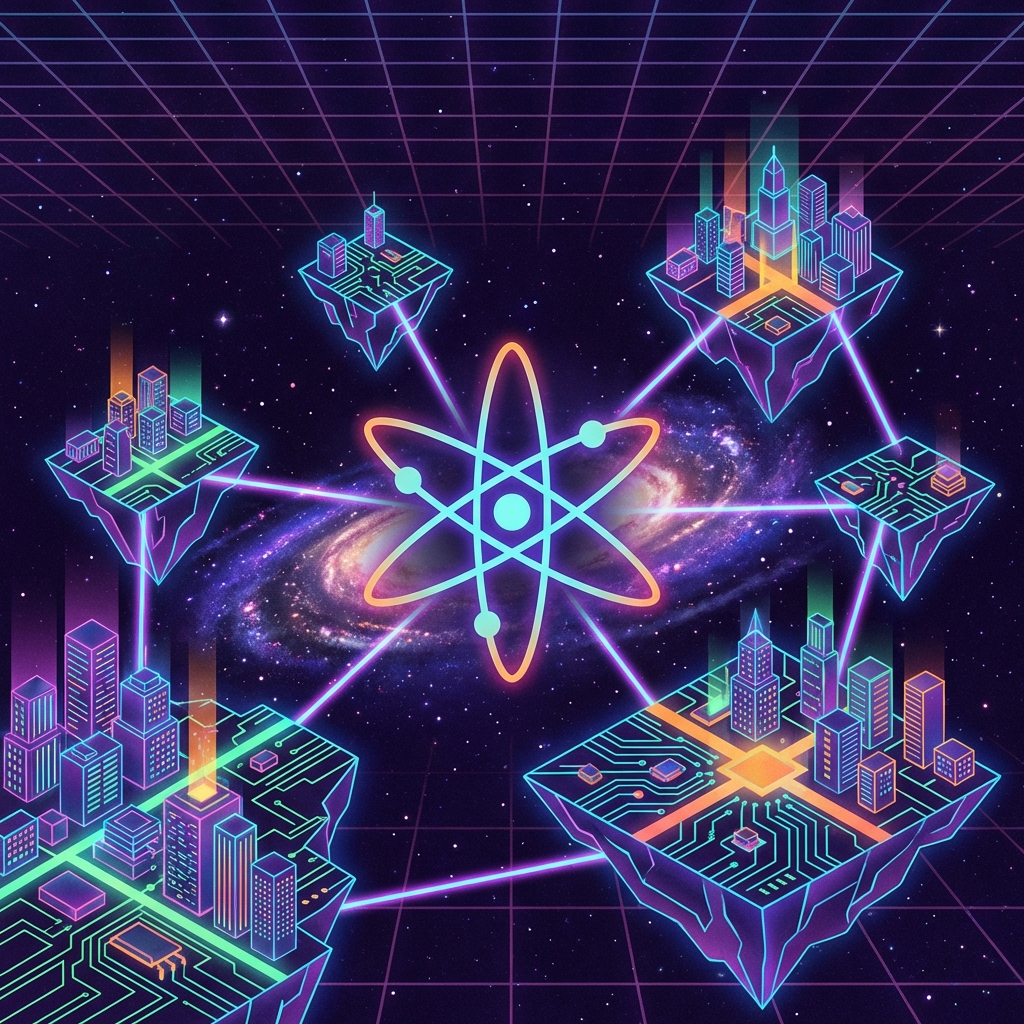
Exploring the Cosmos Ecosystem: Building Interoperable Blockchains
The Fragmented Blockchain Landscape
When I first got into blockchain, I imagined a future where everyone used the same decentralized network. Reality turned out to be very different. Today we have hundreds of blockchains — Ethereum, Bitcoin, Solana, Avalanche, Polygon, and countless others. Each has its own community, its own DApps, and its own isolated ecosystem.
This fragmentation creates real problems. If you want to move assets from Ethereum to Solana, you typically need to use a centralized exchange or a bridge smart contract — both of which introduce trust assumptions and security risks. It's like having different countries with incompatible currencies and no banks to exchange them.
The question that kept bothering me was: does it have to be this way? Can we have multiple specialized blockchains that still work together seamlessly? This is the problem Cosmos set out to solve, and it's why I chose it for building Junction.
The Cosmos Vision: Internet of Blockchains
Cosmos proposes a fundamentally different architecture than monolithic blockchains. Instead of trying to do everything on one chain, Cosmos envisions an ecosystem of application-specific blockchains (called "zones" or "app-chains") that can interoperate securely through a protocol called IBC (Inter-Blockchain Communication).
Think of it like the Internet itself. We don't have one giant computer serving all websites. Instead, we have millions of servers, each optimized for their specific purpose, all communicating through standardized protocols (TCP/IP, HTTP). Cosmos aims to do the same for blockchains.
The core insight is simple but powerful: different applications have different requirements. A DEX needs low latency and high throughput. An NFT marketplace needs cheap storage. A gaming platform needs predictable, low-cost transactions. Rather than compromising on a general-purpose chain, why not let each application have its own chain, optimized for its specific needs?
Why App-Chains Make Sense
Let me explain why the app-chain model is compelling through real-world examples:
1. Performance and Customization
On Ethereum, your DApp competes with thousands of other applications for block space. When there's a popular NFT mint or token launch, gas fees spike for everyone. Your DEX users suddenly can't afford to trade. This is the "noisy neighbor" problem.
With an app-chain, you have the entire blockchain to yourself. You control:
- Block size and time
- Gas pricing models (you could even subsidize gas for users)
- State rent and storage policies
- Execution environment optimizations specific to your application
For Junction, we needed fast finality for cross-chain asset transfers and specific smart contract capabilities. Building an app-chain let us optimize for exactly these requirements without compromise.
2. Sovereignty and Governance
On a shared blockchain, protocol changes require convincing the entire ecosystem. If you want to add a new opcode, change the gas model, or modify consensus parameters, you need to go through a lengthy governance process involving people who don't use your application.
With an app-chain, your community governs the chain. You can:
- Upgrade the chain on your own schedule
- Make breaking changes if needed
- Experiment with new features without ecosystem-wide buy-in
- Implement application-specific governance mechanisms
This sovereignty is crucial for innovation. You can move fast and try things that would never fly on a conservative, shared chain.
3. Economics and Value Capture
On Ethereum, you deploy a smart contract and pay rent (gas fees) to the network forever. The value you create (through transaction fees and MEV) accrues to ETH validators, not your application.
With an app-chain, you can design your own economics:
- Your application's token can be the gas token
- Transaction fees and MEV accrue to your validators/stakers
- You can implement application-specific fee mechanisms
- Revenue shares can go directly to your community or development fund
This changes the economics dramatically. Successful applications can capture the value they create rather than leaking it to the base layer.
4. Security Model Flexibility
Different applications need different security models. A high-value DeFi protocol might want maximum decentralization with 100+ validators. A gaming chain might accept 20 validators for better performance. An enterprise chain might use known, KYC'd validators.
App-chains let you choose. You can even start with a small validator set and gradually decentralize as your application matures and accumulates value.
Understanding IBC: The Magic Behind Interoperability
The real innovation in Cosmos is IBC — the protocol that lets these independent blockchains communicate securely. Let me explain how it works, because it's genuinely clever.
The Challenge
Imagine Chain A wants to send a message to Chain B. How can Chain B verify that Chain A really sent this message? On a monolithic blockchain, this is trivial — they share the same state. But these are separate chains with separate validators.
The naive solution is to trust a third party (a bridge operator) to relay messages. But this introduces trust assumptions and creates honeypots for attackers. We've seen this fail repeatedly with bridge hacks costing billions of dollars.
The IBC Solution: Light Clients
IBC uses light clients for verification. Here's how it works:
Chain B runs a light client of Chain A. A light client doesn't need to store the entire state or replay all transactions. It only tracks the validator set and block headers of Chain A.
When Chain A wants to send a message to Chain B:
- The message is committed to Chain A's state (stored in the state tree)
- Chain A produces a Merkle proof showing that this message exists in its state
- A relayer (can be anyone — it's permissionless) picks up this proof and submits it to Chain B
- Chain B's light client verifies:
- The block header is valid and signed by Chain A's validators
- The Merkle proof correctly shows the message in Chain A's state
- If valid, Chain B accepts the message
This is trustless. You don't need to trust the relayer (they can't forge messages). You don't need a multi-sig or oracle. You're trusting the same cryptographic primitives that secure blockchains themselves.
Connection, Channels, and Packets
IBC has a layered architecture similar to TCP/IP:
Transport Layer (IBC/TAO): Handles connections and light client verification. This is the core protocol that establishes trust between chains.
Application Layer (IBC/APP): Specific application protocols built on top. Examples:
- ICS-20: Token transfers (like moving ATOM from Cosmos Hub to Osmosis)
- ICS-27: Interchain accounts (control an account on another chain)
- ICS-29: Fee payment for relayers
This modularity is powerful. New IBC applications can be built without changing the core protocol, similar to how new applications can be built on TCP without changing TCP itself.
Relayers: The Unsung Heroes
Relayers are off-chain processes that watch multiple chains and relay IBC packets between them. They're similar to miners in proof-of-work — they're incentivized to do work that's valuable to the network.
Anyone can run a relayer. They earn fees (when ICS-29 is enabled) for relaying packets. This creates a permissionless, decentralized relaying network.
In practice, many chains run their own relayers for critical connections, but the permissionless nature means the network is resilient and decentralized.
The Cosmos SDK: Building Blocks for Blockchains
To make building app-chains practical, Cosmos provides the Cosmos SDK — a modular framework for building blockchains. Instead of implementing consensus, networking, and all the blockchain primitives from scratch, you can focus on your application logic.
The SDK is organized into modules:
Core modules (included by default):
- auth: Accounts and transaction authentication
- bank: Token balances and transfers
- staking: Proof-of-stake mechanics
- governance: On-chain governance
- slashing: Validator punishment for misbehavior
- ibc: Inter-blockchain communication
Custom modules (you build these):
- Your application-specific business logic
- Custom transaction types
- Application state
Building a blockchain with the SDK feels like building a web application with a framework like Rails or Django. The framework handles the plumbing, and you focus on your application.
Here's a simplified example of defining a custom module in the SDK:
```go type AssetModule struct { keeper Keeper }
// Handle transactions func (m AssetModule) HandleMsg(ctx sdk.Context, msg sdk.Msg) sdk.Result { switch msg := msg.(type) { case MsgCreateAsset: return m.handleCreateAsset(ctx, msg) case MsgTransferAsset: return m.handleTransferAsset(ctx, msg) default: return sdk.ErrUnknownRequest("Unknown message type") } }
// Query state func (m AssetModule) HandleQuery(ctx sdk.Context, path []string) ([]byte, error) { switch path[0] { case "asset": return m.keeper.GetAsset(ctx, path[1]) default: return nil, sdkerrors.Wrap(sdkerrors.ErrUnknownRequest, "unknown query") } } ```
This modularity makes development fast. You're not reinventing wheels — you're composing battle-tested components.
Tendermint: BFT Consensus Out of the Box
Cosmos chains typically use Tendermint consensus (now called CometBFT). This is a huge advantage because consensus is hard to get right, and Tendermint is a production-grade BFT consensus engine that just works.
Key properties:
- Fast finality: Blocks are final in ~6 seconds (one block time)
- Byzantine fault tolerance: Tolerates up to 1/3 of validators being malicious
- Proof-of-stake: Validators are selected based on bonded tokens
- Light client friendly: Designed for efficient light client verification (critical for IBC)
Using Tendermint means you get instant finality (no long confirmation times like Bitcoin) and a battle-tested consensus layer. You can focus on application logic rather than worrying about consensus bugs.
Real-World Experience: Building Junction
Let me share some practical insights from building Junction as a Cosmos app-chain:
Development Velocity
The Cosmos SDK significantly accelerated development. We went from concept to testnet in about 3 months — something that would have taken 6-12 months if building from scratch.
The modularity meant we could focus on our core value proposition (cross-chain asset management) rather than reimplementing basic blockchain functionality.
Interoperability Benefits
IBC opened up immediate use cases. On day one of mainnet, users could:
- Move assets from Cosmos Hub, Osmosis, and other IBC-enabled chains
- Interact with DeFi protocols across the ecosystem
- Participate in cross-chain governance
This network effect is powerful. We didn't launch into a vacuum — we launched into an existing ecosystem with users, liquidity, and infrastructure.
Performance Trade-offs
App-chain performance is excellent for our use case. With ~6 second block times and blocks that are rarely full, transaction latency is predictable and low.
The main limitation is that Tendermint consensus doesn't scale to thousands of transactions per second. For our application (complex financial logic with moderate transaction volume), this is fine. For a high-frequency trading DEX, you might need different trade-offs.
Operational Complexity
Running your own chain has operational overhead:
- Validator recruitment and relations
- Network upgrades and coordination
- Infrastructure and monitoring
- Security and incident response
This is more complex than deploying a smart contract on Ethereum. But the control and flexibility are worth it for applications that need them.
Challenges and Future Directions
The Cosmos ecosystem is still evolving. Some challenges:
Shared Security
Currently, each Cosmos chain needs its own validator set. For new chains with low market cap, bootstrapping security is hard. Interchain Security (ICS) aims to let chains rent security from the Cosmos Hub, similar to how Polkadot parachains share security.
This is launching in phases and will significantly lower the barrier to launching new chains.
Liquidity Fragmentation
With many chains, liquidity gets fragmented. A token might exist on 10 different chains with different prices and liquidity depths. Cross-chain DEXs and aggregators are emerging to solve this, but it's still a challenge.
User Experience
Asking users to understand different chains, maintain separate wallets, and manually bridge assets is not great UX. We need better abstraction layers — wallets and DApps that handle cross-chain complexity behind the scenes.
Projects like Keplr wallet and Skip protocol are making progress here.
Standardization
With sovereignty comes the risk of fragmentation. We need standards for common patterns:
- Token representations across chains
- Account abstraction
- Smart contract interfaces
- Governance mechanisms
The community is actively working on these through Cosmos Improvement Proposals (CIPs).
Why I'm Bullish on Cosmos
Having built on multiple blockchain platforms, here's why I'm particularly excited about Cosmos:
1. It scales socially. The app-chain model lets teams move independently without coordinating with a monolithic ecosystem. This enables faster innovation.
2. It scales technically. Instead of cramming everything into one chain, you can have many specialized chains operating in parallel.
3. It's pragmatic. Cosmos doesn't chase theoretical perfection. It provides battle-tested components that work today.
4. It's aligned with reality. The future likely isn't one blockchain to rule them all — it's many chains serving different purposes, and they need to interoperate.
Conclusion
The Cosmos ecosystem represents a different philosophy for blockchain architecture: embrace specialization and diversity rather than trying to build one chain for all purposes. Use cryptographic protocols (IBC) rather than trusted intermediaries for interoperability.
Is it the right approach for everyone? No. If you're building a simple DApp that doesn't need customization, deploying on Ethereum or another established smart contract platform might be easier.
But if you need:
- Performance and customization beyond what shared chains offer
- Sovereignty over your protocol evolution
- Capture of value your application creates
- True interoperability across an ecosystem
Then the Cosmos app-chain model is compelling.
The tooling is mature, the community is strong, and the ecosystem is growing rapidly. If you're thinking about building a blockchain application with specific requirements, I'd strongly encourage you to explore Cosmos.
The Internet of Blockchains is not just a vision anymore — it's being built, one app-chain at a time.